
We have made multiple installations using AI avatars. Here are some examples of our projects and collaborations in the museum space.
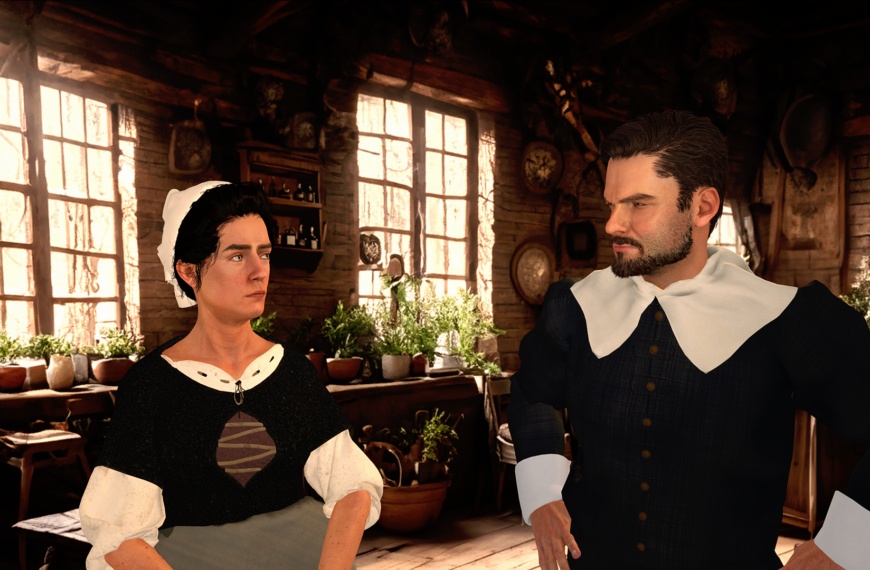
Anders?! Museum de Heksenwaag
Anders?! is an interactive AI-powered playful public experience you can try at Museum de Heksenwaag in Oudewater. It uses 3D characters to lead you through an interactive story on exclusion and discrimination. It showcases the story of witch prosecution, but it also shows how people are confronted with witch hunts on social media in current times. As the visitors talk to the characters, they discover that things are not as they appear. The player can then try to influence the outcome of the discussions. Read more about the project..
Kamp Amersfoort
Nationaal Monument Kamp Amersfoort (NMKA) intends to use AI technology to engage young people in an innovative way with the history of Kamp Amersfoort and the complex dilemmas faced by prisoners during World War II. The museum is developing an interactive installation where groups of young visitors can engage in conversations with a virtual character representing a former camp prisoner. Through their questions, the visitors will influence the themes that are explored, such as the moral gray areas between right and wrong under camp rule. This unique project aims not only to keep the camp’s story alive but also to inspire reflection on contemporary challenges. Additionally, we helped in transcribing 300 hours of interviews with survivors to make these stories more accessible and integrate them into the interactive experience. The goal is to create a meaningful group interaction that resonates with the perspectives and experiences of today’s youth. This project is currently in development. Read more about the project

Museum Tuebingen: Curator tool
The Institute for Classical Archeology of the University of Tübingen asked us to help their students with creating a Museum exhibition in VR. ImproVive used a number of scanned objects and high resolution of images to create a realistic collection of objects. The students can choose objects from a virtual storage room and position them in the space using different pedestals. Special feature is the possibility of an interactive guide that can give an explanation about the exposition or certain objects. Further, the students can enlarge the objects to appear larger than in real life, thus enabling viewers to get a better impression of small objects such as coins or Egyptian grave objects. The Museum lab supports both multi-user creation of a room, as well as allowing people to visit the exhibition together in VR. We see that with the advances of our AI-based avatars, which can help simplify the curation tool and make it much more powerful, the combination of such a tool is being explored in 2026 for other applications.


